How much does an AngularJS to Angular migration cost?
An AngularJS to Angular migration for a small SaaS costs about $10,000 to $40,000 and takes 1 to 4 months, going by the one published vendor range I found. A mid-size product runs $40,000 to $150,000 over 4 to 9 months, and the size of your codebase decides most of it.
AngularJS to Angular: $10,000 to $40,000 for a small SaaS (1 to 4 months), $40,000 to $150,000 for a mid-size product, $150,000 to $300,000+ for a large enterprise system. The vendor notes these are not fixed rates.
From my work
On Mom Software the code was on Angular 10, not AngularJS, but the decision was the same one you face. The legacy code followed no pattern and carried a lot of dead code and unused libraries. We started from scratch on a Fuse template and moved the old code across module by module. Porting it as it was would have moved the mess too.
Why teams still have to move
Google’s long-term support for AngularJS ended on 31 December 2021. The GitHub repository was archived in April 2024 and is read-only. The last version on npm is 1.8.3, published in April 2022. Your app keeps running, but no one at Google ships a security fix for it any more.
The security problems did not stop with the support. GitHub’s advisory database lists ten vulnerabilities in the angular package published since then, two of them rated high, the latest in June 2026. None has a patched version. The records for both high ones say the package “will not receive any updates to address this issue”.
Paid extended support exists from third parties such as HeroDevs and OpenLogic, with patched builds of AngularJS. None of them publishes a price. That buys you time. You are still on AngularJS at the end of it.
The numbers as text
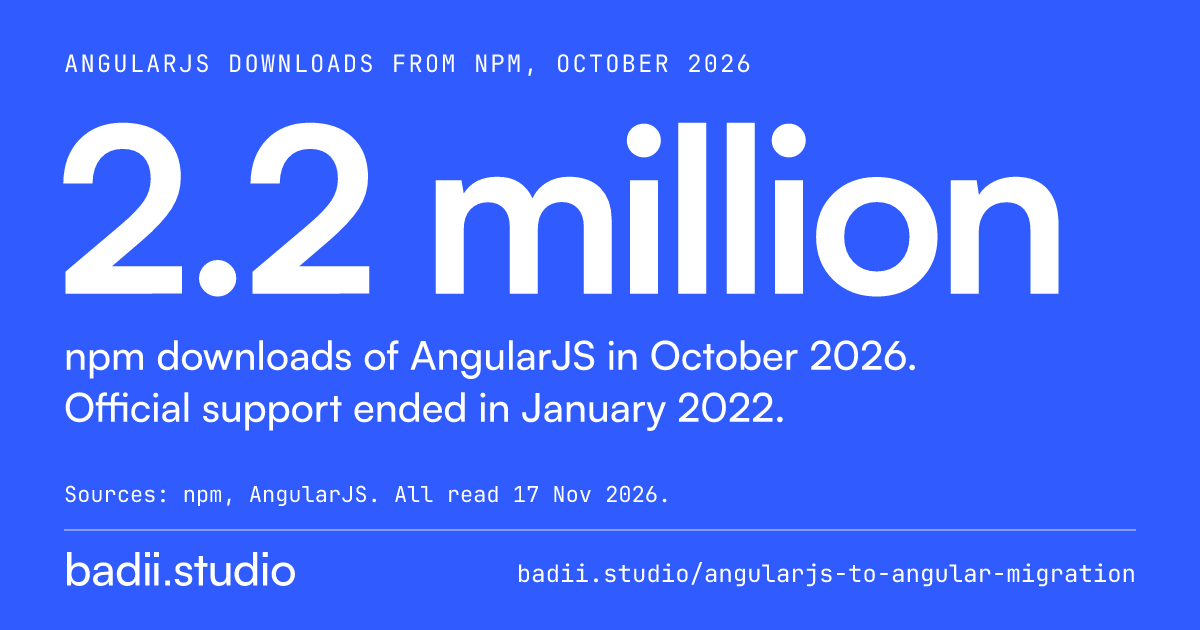
- 2.2 million: npm downloads of AngularJS in October 2026. Official support ended in January 2022.
Cite as: badii.studio, "AngularJS downloads from npm, October 2026", https://badii.studio/angularjs-to-angular-migration#angularjs-npm-downloads
Hybrid or rewrite
Angular still ships an official bridge. UpgradeModule, in the @angular/upgrade/static package, runs AngularJS and Angular in the same app, so you can move one screen at a time while the old ones keep working. The docs mark it stable.
The Frontend Company puts small products on the hybrid path, mid-size ones on either, and says large enterprise systems end up as a rewrite in 90% of cases, over 9 to 12 months or more. That 90% is the vendor’s own view and no study stands behind it. I still think the logic holds: the hybrid bridge costs something on every screen, and on a very large app those costs add up past the price of starting clean.
What breaks in an AngularJS to Angular migration
- Two-way binding on $scope. Angular has no $scope, so state moves into components and services.
- Controllers and directives written as one big file, usually the file nobody wants to open. They have to be split before they can be ported.
- Code that calls $apply or $digest by hand. Each call was a patch for a view that would not refresh, and it hides bugs that only show up once the change detection changes.
- Old third-party AngularJS modules with no Angular version. Each one needs a replacement or a rewrite.
- Tests written for Karma and AngularJS mocks. Most need rewriting with the components they test.
How long it takes: the XLTS formula
XLTS, which sells extended support for AngularJS, gives a simple estimate: lines of code divided by the lines your team writes per week, times 1.4. The 1.4 is a 40% buffer for learning the new framework. A 100,000-line app with a team that writes 1,000 lines a week comes out at 140 weeks, about 2.7 years. Drop the buffer if your team already knows modern Angular well.
Run that formula before you talk to any vendor, me included. If the number scares you, the formula is doing its job. Cut the dead code first, then run it again.
Steps on the hybrid path
- Delete dead code and unused modules first. Every file you remove is a file you don’t port.
- Get the AngularJS side into shape: one component per file, component directives instead of loose controllers, and TypeScript if the build allows it.
- Bootstrap both frameworks with UpgradeModule, so AngularJS and Angular run in the same page.
- Move services first and expose each one to the AngularJS side with downgradeInjectable. Then move leaf components and use them in old screens with downgradeComponent.
- Move whole routes once their components are ported, and hand the URL to the Angular router.
- Remove AngularJS and the upgrade package when the last screen has moved. It is the one commit everybody wants their name on.
Angular migration service: how I run one
I read five Angular migration service pages on 11 November 2026, and none of them publishes a price for the work. Mine starts with a fixed first step at $995, the 14-day Trial, so you know the cost before the first call and you get something you can use even if you take the migration elsewhere.
- Days 1 to 5: I read the AngularJS code and send a written map. Screens, services, third-party modules with no Angular version, the dead code to delete first, and a hybrid or rewrite call with reasons.
- Days 6 to 14: the first real steps in your repo, sized to fit the days left. For example dead code removed, the build made ready for both frameworks, or one service moved, so the path is tried on your code.
- After that: the migration runs as tasks on a monthly plan, one screen or module at a time, while the old screens keep working and you keep shipping.
- I do the work and I answer for it. I was the Angular consultant at Mom Software, and The Merchant Engine’s admin is an Angular app whose code you can read.
Where I would start
The 14-day Trial is $995, one time. In the first 5 business days you get a map of the code and its dependencies, the upgrade path in steps and the risks, ranked. I then make the first fixes that fit in the 14 days, and it ends with a written plan for the rest and a walkthrough call. The migration itself runs as tasks on a monthly plan, the Limited plan at $1,995 a month or the Full plan at $4,995 a month, with the number of months agreed on the kickoff call. The Trial fee is credited to your first month if you start a monthly plan within 14 days of the Trial ending. I sell this, so read the market range above with that in mind.
Questions people ask
Is AngularJS still being used?
Yes. The angular package was downloaded 2,238,412 times from npm in October 2026, almost exactly the same as in October 2025. Downloads count installs and build servers, not companies, but the number is not falling.
Is AngularJS different from Angular?
Yes, they are two frameworks. AngularJS is every 1.x version. Angular is version 2 and later, a full rewrite in TypeScript with components in place of controllers and $scope. That is why ng update cannot take you from one to the other.
When was AngularJS discontinued?
Long-term support ended on 31 December 2021. The AngularJS site puts it this way: “AngularJS support has officially ended as of January 2022.”
Is there a new version of AngularJS?
No. 1.8.3 is the last release, published on npm in April 2022. The only newer builds are the paid ones from extended support sellers.
What replaced AngularJS?
Angular, version 2 and later. The current version is Angular 22, released on 3 June 2026.
Angular upgrade guide: where each version stands
Does Angular have a future, or is React replacing it?
Angular is not shrinking. Its core package was downloaded 27.5 million times from npm in October 2026, up from 19 million a year earlier, and version 23 is planned for June 2027. React is downloaded far more often, but that does not make Angular a dead end. If your team knows Angular, moving to Angular is the shorter road. If you are thinking of React, the guide below covers that move.
Read next
Sources
- AngularJS, version support status, read 17 Nov 2026
- GitHub Advisory Database, advisories for the angular package, read 17 Nov 2026
- GitHub Advisory Database, CVE-2026-11998, 24 Jun 2026
- GitHub Advisory Database, CVE-2024-21490, 10 Feb 2024
- npm, downloads of the angular package, read 17 Nov 2026
- npm, downloads of @angular/core, read 17 Nov 2026
- Angular, releases and support policy, read 17 Nov 2026
- HeroDevs, pricing, read 17 Nov 2026
- OpenLogic, AngularJS long-term support, read 17 Nov 2026
- The Frontend Company, AngularJS to Angular migration, 25 Jun 2025
- XLTS.dev, the math of migrating from AngularJS, 16 Jan 2021, updated 5 Mar 2024
- SD Times, AngularJS long-term support is officially discontinued, 12 Jan 2022
- GitHub, angular/angular.js (archived), archived 12 Apr 2024
- npm, angular package, read 17 Nov 2026
- Angular, UpgradeModule API, read 17 Nov 2026