What does technical due diligence check?
Technical due diligence checks whether the product behind a deal is as solid as the pitch says. A full technical due diligence checklist covers the code, security, infrastructure, third parties, the team and the cost of the next stage.
In code audits done mostly for mergers and acquisitions, 97% of transactions included vulnerable open source, with a mean of 786 vulnerabilities per transaction.
From my work
This is the list I go through before taking over any codebase. When I reviewed one client’s app, the code scored 8 out of 10: well written, with a clean separation of concerns, but plain JavaScript on a large project. The worst finding I have had in someone else’s code was a file upload with no type or size checks on either end. Both are the kind of thing a reviewer finds in the first days.
How a technical due diligence runs
There is no standard checklist and no standard process, but the reviews that firms describe follow the same order.
- Scope. Which products and repos, who reads the report, and which questions the deal needs answered.
- Documents and access. Read-only access to the code and the cloud console, plus whatever is written down: architecture notes, runbooks, past security tests.
- Interviews. The people who build and run the product, because much of what matters is not written anywhere.
- The review. The code and the setup read by a person, with scanners run beside it.
- The report. Findings ranked by risk, each with what it would cost to fix.
- The walkthrough. One call with the people who have to act on it.
Code and architecture
- How the code is split, and whether the boundaries hold.
- Types, tests and their coverage on the flows that make money.
- Dead code, duplicated logic and unused libraries.
- How long a new developer takes to ship a first change.
- Framework and runtime versions, and whether they still get updates.
Security
- Auth, sessions, password reset and role checks on every endpoint.
- Secrets in the code, the git history or the front-end bundle.
- File uploads checked for type and size on both the front end and the back end.
- Dependencies with known vulnerabilities.
- Encryption of personal data, and where the keys live.
- Evidence, if it exists: past penetration tests, a SOC 2 report, and how the last incident was handled.
Infrastructure
- Where it is hosted, who owns the accounts, and who has access.
- How code reaches production, whether more than one laptop can do it, and how a bad release is rolled back.
- Backups, and whether anyone has tested a restore.
- Monitoring and alerts, and who gets woken up.
- What happens on the day traffic triples.
Third parties, licences and data
This is where automated scans find the most. In the same Black Duck audits, 94% of transactions included components with licence conflicts, and 16% of the open source was only found by looking past the package manager: copied files, snippets and code from AI assistants.
- Which vendors, APIs and no-code tools the product cannot run without, and what leaving them would cost.
- Open source licences that could conflict with how the product is sold.
- Code copied in from outside the package manager.
- What personal data the product holds, where it is stored and who can reach it.
- Which AI tools the team uses, and whether code or customer data is sent to an AI provider.
Team and process
- Who knows which part of the system, and what stops if one person leaves.
- How code is reviewed and released.
- Contractors and agencies, and whether the company owns their work. Look for a signed assignment from each one.
- Who holds the domains, the trademarks and the app store accounts.
- How the roadmap is set and how often it slips.
Cost and scale
- The cloud bill, and what drives it.
- The known limits: the table, the queue or the server that breaks first.
- The work needed before the next stage, with a rough cost.
Questions investors typically ask
- Who owns the code and the IP, including work by contractors?
- What would it take to handle ten times the users?
- What are the three biggest technical risks, and what would they cost to fix?
- Has there been a security incident, and how was it handled?
- Could the team keep shipping if the lead engineer left?
- Which third parties could stop the product if they changed their prices or shut down?
- How much of the roadmap is new product, and how much is maintenance?
What the report contains
Firms that describe their reports describe the same shape: a one-page summary first, then findings by area with the evidence, a rank or a cost for each, and a plan for what comes after. One firm puts its report at about 25 pages.
Ask to see a sample before you hire anyone. A report with no ranking and no costs leaves you to work out what matters, and that was the job you paid for.
Standards worth checking against
- OWASP ASVS 5.0.0, for what a security review of a web app should cover.
- NIST SP 800-218, the Secure Software Development Framework, for how the team builds and releases. Version 1.1 is the final one. A draft of version 1.2 has been out since December 2025.
- The SPDX License List, for naming open source licences the same way everyone else does.
- OpenSSF Scorecard, a free automated check you can run on a public repository and on the open source you depend on. It does not replace reading a private codebase.
How founders should prepare
Run the checklist on yourself before the investor’s reviewer does. Fix the cheap items and write down the expensive ones with a plan and a cost. A reviewer forgives a known problem with a plan much faster than one they had to dig up themselves.
The scorecard below is the same list on one page. Print it, score each line yes, partly or no, and bring the “no” lines with a plan.
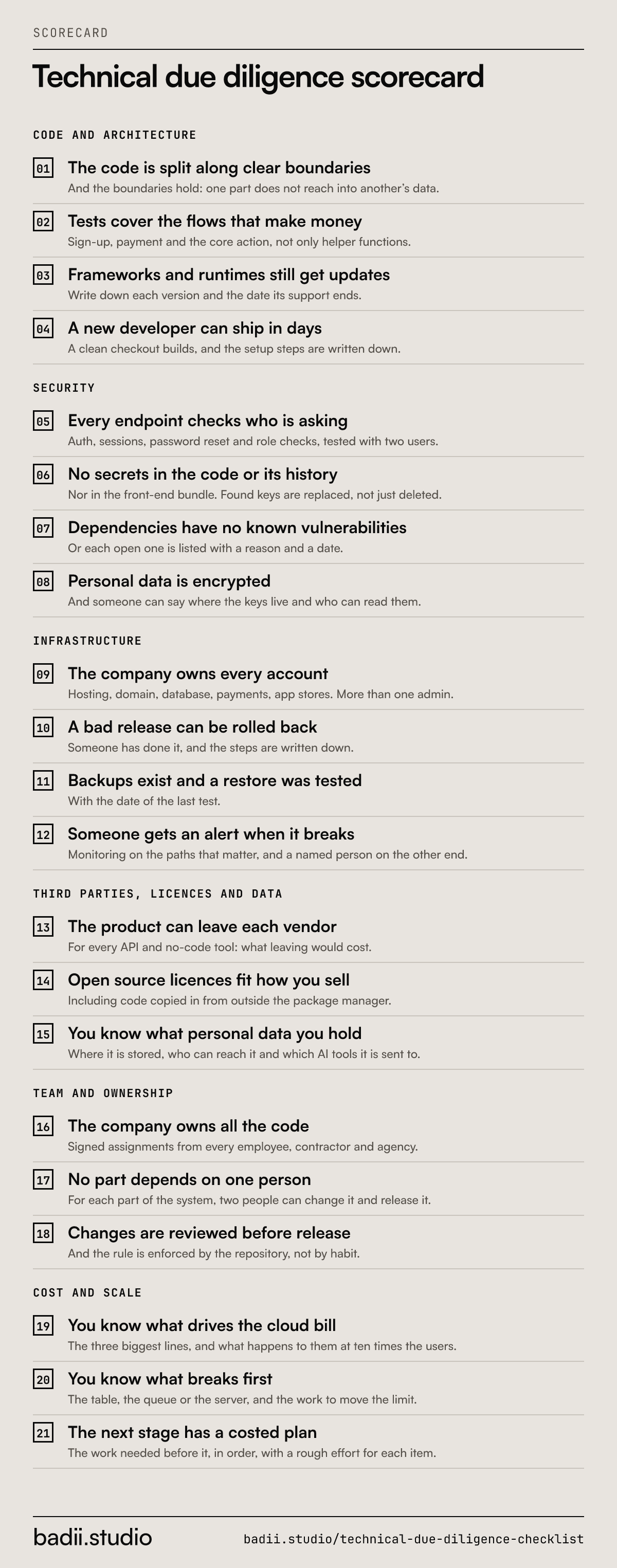
The numbers as text
- The code is split along clear boundaries: And the boundaries hold: one part does not reach into another’s data.
- Tests cover the flows that make money: Sign-up, payment and the core action, not only helper functions.
- Frameworks and runtimes still get updates: Write down each version and the date its support ends.
- A new developer can ship in days: A clean checkout builds, and the setup steps are written down.
- Every endpoint checks who is asking: Auth, sessions, password reset and role checks, tested with two users.
- No secrets in the code or its history: Nor in the front-end bundle. Found keys are replaced, not just deleted.
- Dependencies have no known vulnerabilities: Or each open one is listed with a reason and a date.
- Personal data is encrypted: And someone can say where the keys live and who can read them.
- The company owns every account: Hosting, domain, database, payments, app stores. More than one admin.
- A bad release can be rolled back: Someone has done it, and the steps are written down.
- Backups exist and a restore was tested: With the date of the last test.
- Someone gets an alert when it breaks: Monitoring on the paths that matter, and a named person on the other end.
- The product can leave each vendor: For every API and no-code tool: what leaving would cost.
- Open source licences fit how you sell: Including code copied in from outside the package manager.
- You know what personal data you hold: Where it is stored, who can reach it and which AI tools it is sent to.
- The company owns all the code: Signed assignments from every employee, contractor and agency.
- No part depends on one person: For each part of the system, two people can change it and release it.
- Changes are reviewed before release: And the rule is enforced by the repository, not by habit.
- You know what drives the cloud bill: The three biggest lines, and what happens to them at ten times the users.
- You know what breaks first: The table, the queue or the server, and the work to move the limit.
- The next stage has a costed plan: The work needed before it, in order, with a rough effort for each item.
Cite as: badii.studio, "Technical due diligence scorecard", https://badii.studio/technical-due-diligence-checklist#technical-due-diligence-scorecard
What it costs
Specialist firms publish prices from about $7,500 to $40,000 for startups, as listed on my technical due diligence page. My 14-day Trial costs $995 for one product, with findings ranked by risk in the first 5 business days. For a deeper role through the deal, the Full plan is $4,995 a month and includes team and investor meetings. I sell this, so read it with that in mind.
Questions people ask
What is the purpose of technical due diligence?
To find out, before money moves, whether the technology is what the pitch says it is, what it will cost to fix or scale, and who it depends on.
What is a due diligence checklist?
A list of what a reviewer asks for and checks, grouped by area. There is no official one. Mend puts it plainly: “there is no industry standard for a technical due diligence checklist”. So compare a few, and use one that ends in a ranked list, not a pile of answers.
What are the three types of due diligence?
There is no fixed list of three. Guides often name legal, financial and commercial, but Thomson Reuters sorts the types into “two general categories”, hard and soft, and other guides list a dozen. Technical due diligence sits beside the others and feeds them: a licence conflict is a legal finding, and a rebuild is a financial one.
Which AI is best for due diligence?
No AI tool does due diligence alone, and the makers say so. Anthropic says its automated security reviews “should complement, not replace, your existing security practices and manual code reviews”. GitHub says Copilot code review “should be supplemented with careful human code review”.
The tools are good at a first pass over a lot of code. They cannot tell you who owns the accounts, what the contractor agreements say or whether a backup restores. I run them beside my own read of the code, not in place of it.
How long does technical due diligence take?
From about two to three weeks at the firms that publish it: Rocking Tech lists 10 and 15 working days for its two tiers. My 14-day Trial sends ranked findings in the first 5 business days.
Read next
Sources
- Black Duck, 2026 Open Source Risk in M&A by the Numbers, 2026
- OWASP, Application Security Verification Standard 5.0.0, 30 May 2025
- NIST SP 800-218, Secure Software Development Framework 1.1, Feb 2022
- NIST SP 800-218 Rev. 1, initial public draft of SSDF 1.2, 17 Dec 2025
- SPDX License List, read 17 Nov 2026
- OpenSSF Scorecard, read 17 Nov 2026
- madewithlove, what is in a technical due diligence report, 23 Jul 2026
- Mend, technical due diligence, 27 May 2021
- Thomson Reuters, due diligence, 23 Aug 2024
- Anthropic, automated security reviews in Claude Code, read 17 Nov 2026
- GitHub Docs, responsible use of Copilot code review, read 17 Nov 2026
- Rocking Tech, technical due diligence, read 17 Nov 2026
- AKF Partners, technical due diligence, seen Nov 2026
- Reyem Tech, pricing, seen Nov 2026