How do you check that a remote developer is real and senior before you hire?
Check three things in this order: that this is a real person or business, that they have done the work they claim, and that you keep control of the code and accounts. Each takes free public tools and a video call. No single check proves anything, so run all ten and look at the pattern.
The FBI on remote IT hires: "Sometimes an individual is employed to pass the initial interview, but the on-the-job work is completed by a different individual."
Why skill checks are not enough
Most hiring guides teach you to judge skill: look at the portfolio, call a reference, run a paid test. That advice is good, and it is in the list below.
It skips an earlier question. Is this one real, accountable person or business, and is the person you met the one who will do the work? US and UK government agencies have published plain lists of what to check when hiring freelance developers. They were written about one kind of fraud, workers hiding who they are, but the checks are useful for any remote hire.
Most remote developers are exactly who they say they are. An honest one passes these checks quickly and will not mind being asked.
Is this a real person or business?
- A live video call before any money. Camera on, a plain background, and the same person on every later call. US and UK guidance both tell buyers to do video interviews, and the UK advisory lists refusing to appear on camera as a warning sign. A call is needed but it is not proof: the FBI has reported face-swapping in video interviews.
- One name everywhere. The same name, photo, location and work history on LinkedIn, GitHub, their own site, any marketplace profile and the contract. People do change names and move, so ask about a mismatch before you judge it.
- A legal identity you can look up. For a company, search the public register: Companies House in the UK, KVK in the Netherlands, the Secretary of State in a US state. In the EU you can also check a VAT number in VIES. For a person trading under their own name, a full legal name and address on the contract is enough.
- Payment goes where the contract says. The invoice and the bank account carry the same name as the contract. A request to pay a third person, to switch accounts midway or to pay in cryptocurrency is a warning sign in both the US and UK guidance. A billing company is fine when the contract names it up front.
What the registers can and cannot tell you
- Companies House shows the registered address, the officers and the filing history for free. It also says it does not check the accuracy of what is filed.
- VIES confirms that an EU VAT number is valid for cross-border trade today. For data protection reasons it may not show you the name and address behind it.
- KVK lets anyone search Dutch businesses by name or number for free. A sole proprietor can have the visiting address hidden, so a missing address is not a warning sign.
- In the US there is no single national register, and the Small Business Administration says a person doing business under their own legal name does not need to register anywhere. Having no company is not a fail.
- No register ties the person on your video call to the business. The contract, the invoice and the bank account do that, when they all carry the same name.
Can they do the work?
- Work you can trace to them. Any one of these: public code with history spread over years, a live product where someone else confirms their role, or a screen share where they open old work and explain why it was built that way.
- Do not read too much into the green squares on GitHub. They are the developer version of a firm handshake. By default the graph shows only public work, so a senior developer with years of private client projects can look like they took those years off. And whoever makes a commit sets its author and date, so a full graph can be made after the fact.
- A reference you reach yourself. Speak to a past client or employer using contact details you found on that company’s own site, not ones the developer handed you. The US guidance recommends exactly this. A confidentiality agreement can block a reference, so one real one is enough.
- A small paid first job. A fixed scope of days, not months, with a written list of what you get, paid at their normal rate, with work shown to you during the job. It shows how someone works, which is a lot. It will not tell you they can run a whole system.
Do you keep control?
- A contract that gives you the code. In both the US and the UK the person who writes the code owns the copyright by default, and moving it to you takes a signed written agreement. Paying for the work is not the same as owning it. Look for a clause that assigns copyright in the work to you. Many contracts move ownership when the invoice is paid, which is normal. This is background, not legal advice.
- Your repo, your accounts. The code lives in a repository your company owns. Hosting, domain, database and payment accounts are in your name. The developer is invited in and can be removed. The FBI has reported remote workers who copied company repositories to their own accounts and held the code hostage.
- The person you met does the work. The contract names who writes the code and says subcontracting needs your consent. Now and then, ask them to walk you through their own changes on a call. Whoever wrote them will find it an easy call.
The numbers as text
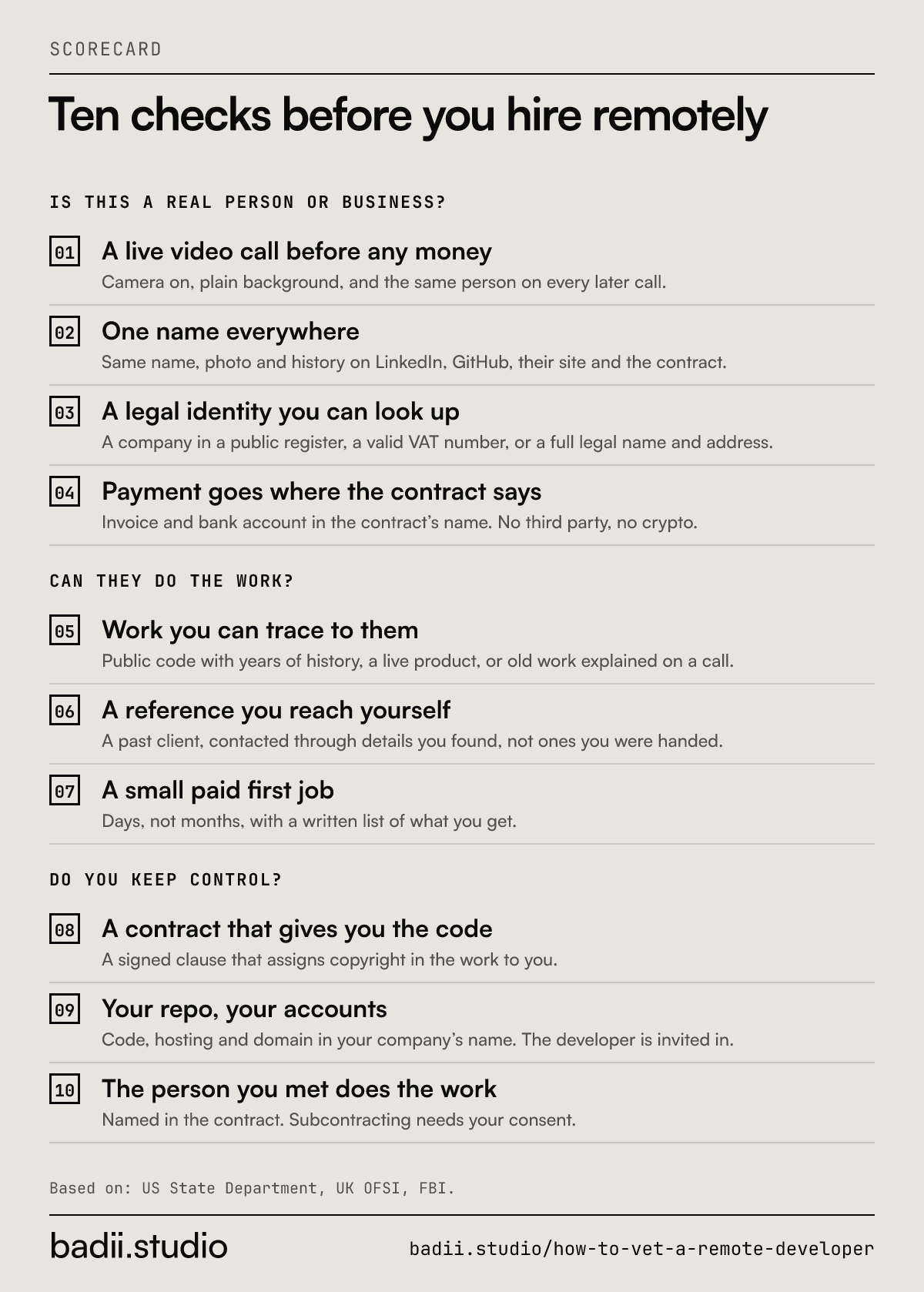
- A live video call before any money: Camera on, plain background, and the same person on every later call.
- One name everywhere: Same name, photo and history on LinkedIn, GitHub, their site and the contract.
- A legal identity you can look up: A company in a public register, a valid VAT number, or a full legal name and address.
- Payment goes where the contract says: Invoice and bank account in the contract’s name. No third party, no crypto.
- Work you can trace to them: Public code with years of history, a live product, or old work explained on a call.
- A reference you reach yourself: A past client, contacted through details you found, not ones you were handed.
- A small paid first job: Days, not months, with a written list of what you get.
- A contract that gives you the code: A signed clause that assigns copyright in the work to you.
- Your repo, your accounts: Code, hosting and domain in your company’s name. The developer is invited in.
- The person you met does the work: Named in the contract. Subcontracting needs your consent.
Cite as: badii.studio, "Ten checks before you hire remotely", https://badii.studio/how-to-vet-a-remote-developer#remote-developer-ten-point-check
How to read the result
No single check decides. The FBI says in its October 2026 notice that these workers "cannot be identified reliably with a single indicator", and warns that aggressive controls carry a high risk of false positives that could harm legitimate employees. The UK advisory says its warning signs matter most when two or more show up together.
So do not filter by country, name, accent or price. Run the checks, and when one fails, ask why. A good developer will have a plain answer.
Using AI coding tools is not a fail either. What I would ask is whether a named person reviews the result and answers for it.
Agency or freelancer: the same question
A freelancer is one person who sells the work and does it. An agency is a company that sells the work and assigns it to staff or subcontractors. Neither is safer by default.
Ask both the same thing: who writes the code, and will I meet them? With an agency, ask for the names. A good sales call only tells you the agency can sell. With a solo developer, ask what happens when they are away.
Where to find developers
- Freelance marketplaces. Wide choice, but the marketplace does not check who the person is for you.
- Vetted networks. They test skill before you see a profile. You still check identity and the contract.
- Referrals from people you trust. The reference check is half done already.
- Developers who sell direct, from their own site or a community thread. You do every check yourself, and you deal with the person who does the work.
Run these checks on me
It would be odd to publish ten checks and then fail them, so here is where to start with me.
- Video call: ask and I join on camera the same day.
- One name: my LinkedIn and GitHub are linked from the home page.
- Legal identity: invoices come from Pan African Center for Entrepreneurship, KVK number 42137049, VAT number NL005525168B29. Look both up.
- Traceable work: The Merchant Engine is open source.
- Your repo, your accounts: everything I write lives in your repository from the first day.
- A small first job: the 14-day Trial, $995, with a written list of what you get.
- Ask me for the contract before you pay, and read the ownership clause.
Read next
Sources
- US State Department, Treasury and FBI, guidance on DPRK IT workers, 16 May 2022
- UK OFSI, advisory on North Korean IT workers, 12 Sep 2024
- FBI, I-012325-PSA, data extortion by remote IT workers, 23 Jan 2025
- FBI, I-072325-4-PSA, IT worker threats to US businesses, 23 Jul 2025
- FBI, I-101326-PSA, 13 Oct 2026
- Companies House, find and update company information, read 17 Nov 2026
- KVK, what the Dutch Business Register contains, read 17 Nov 2026
- Your Europe, check a VAT number (VIES), read 17 Nov 2026
- US Small Business Administration, register your business, read 17 Nov 2026
- GitHub Docs, contributions on your profile, read 17 Nov 2026
- GitHub Docs, profile contributions reference, read 17 Nov 2026
- GitHub Docs, displaying verification statuses for all of your commits, read 17 Nov 2026
- US Copyright Office, Circular 30, Works Made for Hire, read 17 Nov 2026
- US Code, title 17, sections 201 and 204, read 17 Nov 2026
- UK Copyright, Designs and Patents Act 1988, section 11, read 17 Nov 2026
- UK Copyright, Designs and Patents Act 1988, section 90, read 17 Nov 2026